
Reviewed · SCHINDLER'S FACTORY TOURS
Tour via Kazimierz Quarter by Golf Cart with Schindler’s Museum in Krakow
Krakow can feel like two cities at once, and this tour is a smart way to connect them. You start in Kazimierz, the former Jewish district, gliding through the streets in a golf cart, then head to Schindler’s Factory for a multimedia museum experience that turns World War II history into something you can actually picture. One heads up: a portion of the day is walking inside the museum, and the tour ends at the museum, with no ride back to your hotel included.
I especially like how the plan balances ease and depth. The cart and audio guide help you get your bearings fast, and you still get a live guide when it matters most inside Schindler’s Factory. I also like that the Kazimierz segment is paced like a guided walk, even though you are not doing it all on foot.
The main consideration for me is logistical, not emotional. You must bring a passport or ID for museum entry, and the ticket names must match your documents exactly, so double check that before you go.
Key highlights I would not miss
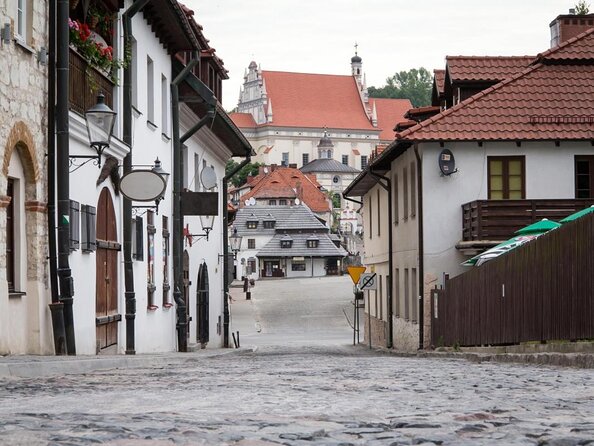
- Golf cart orientation through Kazimierz so you can see more without tiring out early
- Szeroka Street’s big significance, including the story of four synagogues once lining the same street
- Plac Nowy’s evolution, from Jewish Square to today’s cafés, markets, and outdoor social life
- A real connection to deportations, via the preserved ghetto wall fragment and the Umschlagplatz area at Plac Zgody
- Deutsche Emailwarenfabrik in action, with Oskar Schindler’s preserved office and the symbolic ark of survivors made of pots
- Multimedia scenes that move you through daily life, from atelier details to a ghetto apartment and on to Płaszów
Kazimierz by golf cart, with an audio guide that actually helps
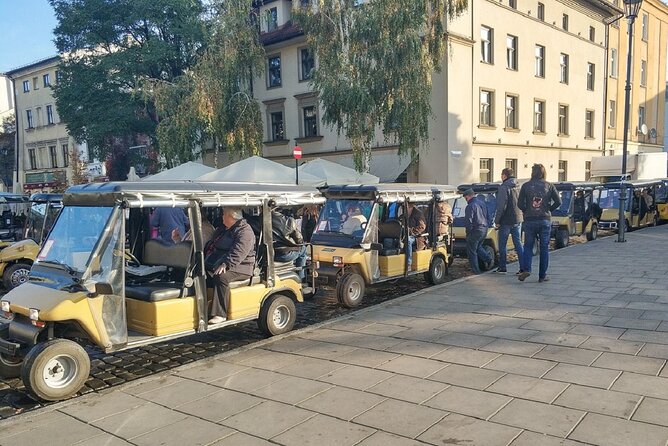
Kicking off in Kazimierz feels like switching on a Krakow playlist you did not know you needed. The golf cart keeps things moving smoothly through the Jewish quarter, and the audio guide gives you context as you roll past the landmarks you would otherwise read about later, when you no longer remember where everything is.
For me, the value here is the choreography. You get a guided sense of place, not just a list of stops, so when you later walk around Kazimierz on your own, you start to spot patterns immediately. A group size cap of 24 also means the experience stays organized, and you are not stuck waiting around forever for the next checkpoint.
Also, the tour is offered in English, which matters because Kazimierz and the museum both reward language clarity. You want to understand what you are seeing, not just hear general descriptions.
More Schindler's Factory tours to compare:
- Krakow: Oskar Schindler’s Factory Entry Ticket & Guided Tour
★ 4.2 · 3,793 reviews - Krakow: Schindler’s Factory Tour with Entrance Ticket
★ 4.5 · 3,182 reviews - Krakow: Schindler’s Factory Skip-the-Line Ticket
★ 4.4 · 3,105 reviews
Szeroka Street: the heart of Kazimierz and a street you should slow down on
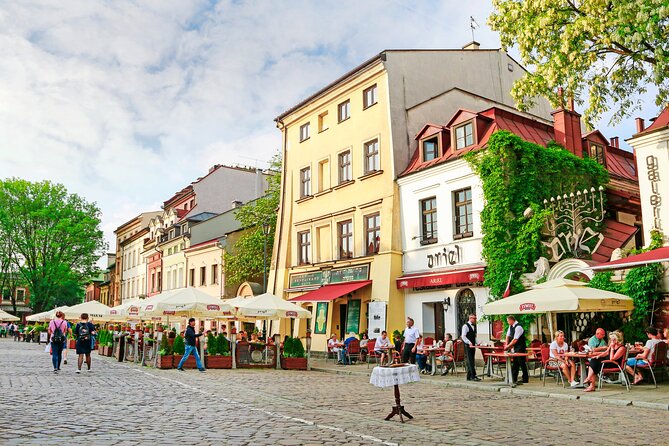
Kazimierz used to be its own world, separate from the city on Wawel Hill, and it was the center of Jewish life in Krakow for centuries. When your tour brings you to Szeroka Street, you are not just looking at architecture. You are looking at a map of community life.
Szeroka Street is especially striking because it once had four synagogues along the same street, a setup described as unheard of elsewhere in Europe. That fact alone makes the street feel different from a normal “main road,” because it signals how concentrated religious and community life used to be.
You also get to stand on Szeroka Street and learn about one of the oldest synagogues in Poland, preserved in particularly good condition. That is one of those details that keeps you from rushing. Even if you are not a church-and-synagogue person, the preservation here helps you understand continuity, not only tragedy.
Practical tip: take your time at the street level. The whole area is about texture and atmosphere, and the tour’s pacing gives you that chance without making you feel like you are stuck in one spot too long.
Plac Nowy: from Jewish Square to cafés, markets, and beer garden nights
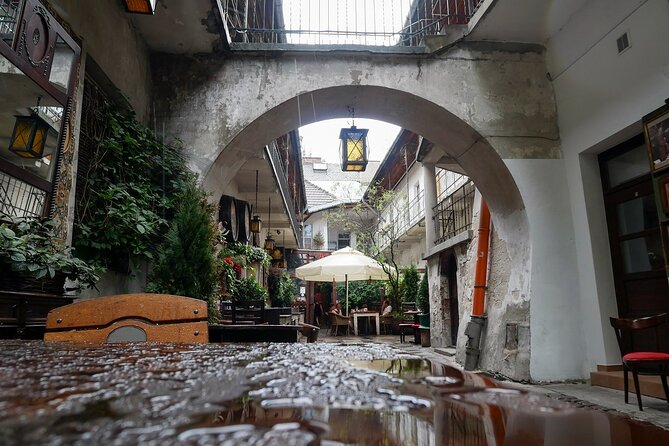
Next you roll into Plac Nowy, which today is a popular meeting place and festival venue. In the past, it was known as Plac Żydowski, or Jewish Square, so you are watching layers of daily life stack on top of each other.
Around 1900, a circular pavilion was built in the middle of the square, with small grocery and butcher shops plus a fast-food bar known for casseroles, still famous in Krakow today. It is a small detail, but it is exactly the kind of practical history that makes a square feel human, not museum-like.
Your guide also sets the scene for how the square shifts through the week. On weekdays you may see stalls with vegetables and antiques, and on Sunday mornings it turns into a clothing market. Then on warm summer nights, cafés and pubs spill out and the whole square becomes one large beer garden.
Why this matters on a tour like this: the Kazimierz portion is not only about suffering. It is also about everyday routines, food, commerce, and social life, which helps the later museum experience hit with clearer context.
The preserved ghetto wall fragment, with a plaque that fixes the memory
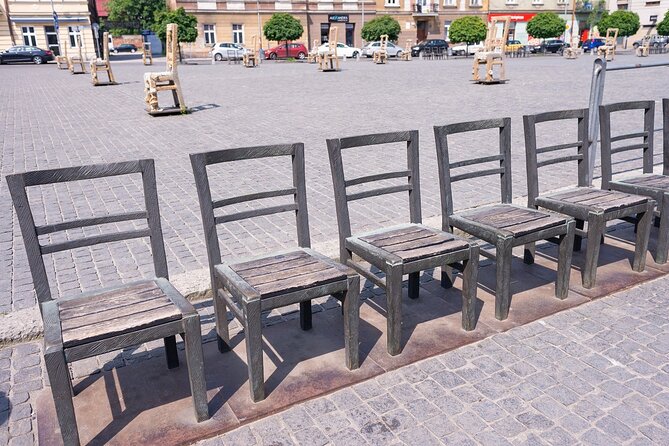
After the square, the tour turns to a small fragment of the original ghetto wall that has been preserved, along with a commemorative plaque about the fate of the inhabitants. This stop is brief, but it is powerful because it is physical, not theoretical.
It is also useful as a transition. Kazimierz helps you understand what was there before, and then the preserved wall piece anchors what was taken away. The tour design uses that contrast on purpose, so you leave the first part with more than just sightseeing photos.
One consideration: if you are prone to getting overwhelmed by heavy topics, give yourself a minute here before moving on. The tour keeps going, but your body does not have to rush.
More Jewish quarter and heritage tours to compare:
- Krakow: Schindler’s Factory & Ghetto Guided Tour
★ 4.7 · 1,694 reviews - Krakow: Jewish Quarter and Former Ghetto Tour
★ 4.9 · 1,441 reviews - Krakow: Bike Tour of Old Town, Jewish Quarter and the Ghetto
★ 4.9 · 1,155 reviews - Krakow: Kazimierz Jewish Quarter Walking Tour
★ 4.8 · 571 reviews
Plac Zgody and Umschlagplatz: where deportations were organized under Nazi occupation
In the Podgórze district, in 1941 the Krakow Ghetto was established, and this is where the story moves into the deportation system. The former Plac Zgody, also called Concord Square, is designated as Umschlagplatz, the place where Jews had to gather before being deported.
This stop matters because it shifts the focus from what was lost locally to how the machinery of persecution worked. You are no longer just seeing remnants of a neighborhood. You are learning about the process that turned civilians into prisoners and then into numbers.
The pacing is important here. The tour does not overload you with facts. Instead, it gives you a clear point on the map, then carries you forward into Schindler’s Factory where the same historical currents are shown through everyday details.
Fabryka Emalia Oskara Schindlera: Deutsche Emailwarenfabrik and Oskar Schindler’s role
Schindler’s Factory is the heart of the second half, and it starts with a key idea: you are visiting Fabryka Emalia Oskara Schindlera, the former headquarters of Deutsche Emailwarenfabrik. That is not a generic memorial site, it is a preserved workplace, and that changes how the story feels.
Your museum time includes a live guide, which makes a huge difference. Multimedia displays help, but a live guide can connect the dots and answer the kinds of questions that pop up when you see an office, a work setting, and a recreated street scene all in one visit.
In this museum segment you learn about Oskar Schindler, the entrepreneur known from the Oscar-winning Spielberg film, and more importantly how he saved many of his employees from their likely fate. The tour also points out Schindler’s heroic deed through the preserved office in the factory administration building.
Then comes one of the most memorable symbols in the collection: a symbolic ark of survivors made of thousands of pots like the ones produced by his employees during the war. It is a small object-driven metaphor, and it works because it stays grounded in work, not speeches.
The multimedia walkthrough: photographer’s atelier, a hairdresser, a tram, and more
Inside, the modern multimedia installation guides you along cobbled city streets. You enter a photographer’s atelier, visit a hairdresser, then get on a tram as part of the experience. That sequence is not random. It is designed to show how normal life was built from countless small scenes.
The museum then brings you into a typical apartment in the Jewish ghetto, and from there you find yourself with its inhabitants in the Płaszów camp. You should expect emotional intensity, but the tour keeps returning to daily-life details, which helps you understand how people lived, not only how they suffered.
Because you will be moving through different themed environments, plan to let your attention go where the installation pulls you. You do not need to read every label. Use the live guide’s direction to focus on the scenes that connect best to the Kazimierz portion you just did.
Practical note: the museum portion includes walking inside. It is not described as a major hiking day, but it is still movement, so wear comfortable shoes.
Timing, logistics, and why the order of stops is smart
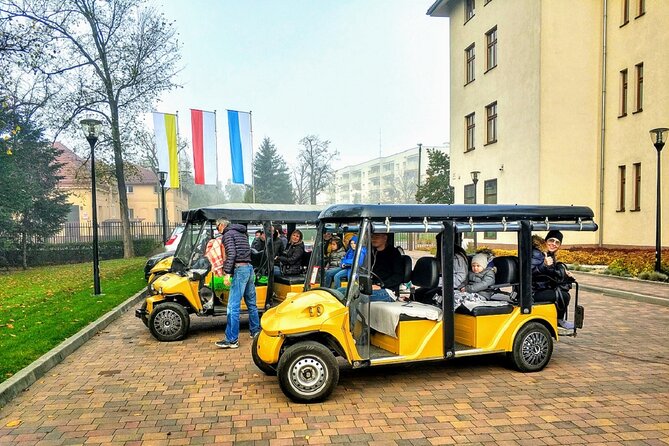
This is a roughly 3-hour experience overall, split into two main blocks of about 1 hour 30 minutes each. The first block is Kazimierz by golf cart with an audio guide, and the second block is the museum with live guidance.
The order makes sense. Starting in Kazimierz gives you the cultural and neighborhood context, so when the museum shifts into factory life and ghetto scenes, you are not seeing it as disconnected tragedy. You have a map in your head, and that map makes the museum easier to follow.
The tour is group-based, with up to 24 people, and it starts at the specified time at the meeting point. Being on time matters here because the cart schedule and museum entry flow depend on it.
Fitness and baggage: the tour notes moderate physical fitness and says no large bags and backpacks are allowed. If you are traveling with a big pack, plan a smaller day bag for the museum portion.
One more practical thing: your tour ends after the museum visit, and transport back to your hotel is not provided. I suggest planning your next stop nearby or booking a taxi or tram based on where you will be after Lipowa 4.
Price and value: $81.88 for cart time plus museum entry and live guiding
At about $81.88 per person for roughly 3 hours, this tour is not a bargain deal. But it is also not overpriced for what you actually get.
You are paying for several bundled items:
- golf cart transportation through Kazimierz
- an audio guide during the cart segment
- a live guide inside Schindler’s Factory
- the museum entrance ticket
For context, Schindler’s Factory can take time to appreciate properly, and having a live guide can save you from feeling lost in the multimedia. The cart part also has real value, because it helps you cover Kazimierz without spending your whole morning walking uneven streets.
When I judge value for tours like this, I look at how much decision-making you do on the ground. Here, most of the hard parts are handled for you, so you can focus on understanding what you are seeing instead of figuring out routes and entrances on the fly.
Who this tour suits best in Krakow
This is a strong fit if you want an efficient Krakow day that still feels guided and meaningful. It works especially well if you:
- like Jewish history and architecture, but do not want to plan every step yourself
- want a clear connection between neighborhood life and the war-era story
- prefer having an audio guide for orientation plus live guidance at the museum
It is also a good choice if you are short on time. You can get a lot of learning in a 3-hour window, which is rare for a topic this heavy.
If you hate group tours, this might feel structured. If you dislike museum pacing that moves you through scenes, you might want to visit the museum at another time with a slower self-guided plan. But for most people, the mix of cart and live guiding is a practical win.
Should you book? My take on the decision
I would book this tour if you want a guided, map-based introduction to Kazimierz followed by Schindler’s Factory with a live guide. The pairing is the main reason it works, Kazimierz first, then the museum, so your understanding builds rather than starting and stopping.
Book it if you want to save effort. The golf cart handles a lot of the movement through the quarter, and the audio guide keeps the story coherent while you are traveling.
Skip it or consider a different format if you want complete control over pacing in the museum. The experience includes walking inside and uses a set multimedia route, so you cannot wander completely freely.
If you do book, do one thing before you go: check that your full names and your ID match exactly for museum entry. That one detail is the difference between a smooth start and a last-minute headache.
FAQ
How long is the Krakow Kazimierz and Schindler’s Factory tour?
The tour is approximately 3 hours total, split into about 1 hour 30 minutes in Kazimierz and about 1 hour 30 minutes at Schindler’s Factory.
Is the tour offered in English?
Yes, the tour is offered in English.
What is included in the price?
Transportation by golf cart through the Kazimierz district, an audio guide on the cart, a live guide at the museum, and an entrance ticket to Schindler’s Factory Museum are included.
Do I need an ID to enter Schindler’s Factory Museum?
Yes. Schindler’s Factory Museum uses personalized tickets, so you need to provide full names for all participants and bring a passport or ID for entry. The name on your ticket must match your document.
Is there walking during the tour?
Yes. Part of the tour involves walking inside the museum while it is operated by a live guide. The rest of the tour is done by golf cart.
Where does the tour start and end?
The tour starts at Mikołaja Zyblikiewicza 2, 31-029 Kraków, Poland, and ends after the museum visit at Lipowa 4, 32-051 Kraków, Poland. The tour does not include transport back to your hotel.
More Museum Tours in Krakow
- Auschwitz-Birkenau Museum and Memorial Guided Tour from Krakow
★ 4.5 · 1,510 reviews - Krakow: Rynek Underground Museum Guided Tour
★ 4.6 · 1,122 reviews - Krakow Schindler’s Factory Museum Guided Tour in English
★ 4.5 · 650 reviews - Krakow: Auschwitz Birkenau Museum Guided Tour with Pickup
★ 3.6 · 544 reviews
More Electric Buggy and Golf-cart Tours to Compare
- Krakow: City Sightseeing Tour by Electric Golf Cart
★ 4.5 · 3,264 reviews - Krakow: City Sightseeing Tour Eco Electric Buggy Golf Cart
★ 4.7 · 3,143 reviews - Krakow: Extended City Sightseeing Tour – Eco Buggy Golf Cart
★ 4.7 · 794 reviews - Krakow: Electric Car Sightseeing Tour
★ 4.4 · 450 reviews
Recently reviewed around Krakow
- Wawel Castle and Cathedral Guided Tour★ 4.6 · 44 reviews
- Walking Tour: Kazimierz, Jewish Quarter – 2-Hours of Magic!★ 4.7 · 35 reviews
- Wawel Castle and Cathedral Guided Tour★ 5.0 · 8 reviews
- Wadowice and Kalwaria: John Paul II Route★ 4.8 · 5 reviews
- Kraków Holocaust Tour★ 4.9 · 5 reviews
- VIP Club Entry and Booth Booking★ 5.0 · 4 reviews
- Walking Tour of Krakow: Old town – 2-Hours of Magic★ 4.7 · 5 reviews
- Krakow: Zakopane, Thermal Baths and Gorce Park Treetop Walk★ 5.0 · 3 reviews