
Reviewed · SCHINDLER'S FACTORY TOURS
Kraków: Schindler’s Factory and Former Ghetto Tour
This tour is interesting because it links the streets of Kraków’s former ghetto with a major WWII-era museum stop, all in one smooth route. I like how you spend real time at the most recognizable memorial sites in Podgórze, and I also like that you ride in a comfortable electric car instead of wrestling with traffic on foot. A fair heads up, though: most of the museum time is self guided, so there may not be a live guide to answer your deeper questions.
What makes it work for you is the structure. You get pre recorded audio that walks you through what you’re seeing, and you’re not stuck just reading signs. The second big thing I like is the way the experience ends at Oscar Schindler’s Factory, where the exhibits connect Kraków’s story and the people living there to the larger Nazi occupation.
One consideration before you book: the museum focus is not centered solely on Schindler the individual, so if you’re hoping for lots of biography about him specifically, you might come away wanting more on that angle.
Key Highlights You Should Not Miss
- Podgórze audio route: Pre recorded narration helps you make sense of what you’re looking at as you move through the district.
- Electric car transport: Quick hops between stops mean less walking and easier photo opportunities.
- Plac Bohaterów Getta focus: You’ll spend time at the Heroes of the Ghetto Square and surrounding memorial areas.
- Apteka pod Orłem stop: The Eagle Pharmacy brings home how repression played out in everyday locations.
- Oscar Schindler’s Enamel Factory museum time: Exhibit storytelling connects Kraków’s WWII disruption to real people’s lives.
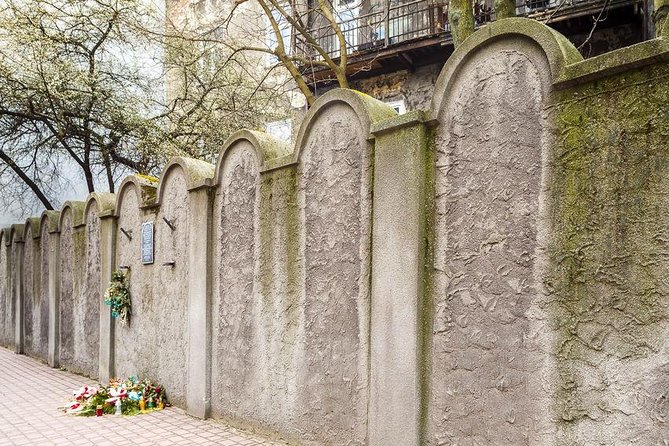
- WWII wall remnants: Seeing leftover boundaries helps you grasp the physical reality of the ghetto.
Why This Podgórze Route Works So Well in Kraków
Kraków can feel like it has a lot going on, but WWII history here is especially important and especially close to the ground. This tour gives you a practical way to understand the former Jewish ghetto area without turning your day into a scavenger hunt. You move through Podgórze with audio that frames each stop, so the memorials don’t stay as isolated plaques.
The tour is built around a simple idea that I think you’ll appreciate: you can only absorb so much from a museum if you do it cold. By starting outside at places like the Heroes of the Ghetto Square and the Eagle Pharmacy, the museum visit lands with more weight. When you finally step into Oscar Schindler’s Factory, the exhibition has context. You’re not just looking at objects and photos, you’re connecting them to locations tied to the neighborhood people were forced to endure.
I also like the transportation approach. The electric car or electric buggy style ride keeps things comfortable, which matters because memorial areas can involve stops with standing and short walking segments. You can also take photos more easily when you’re not constantly checking where you’re going next.
More Schindler's Factory tours to compare:
- Krakow: Oskar Schindler’s Factory Entry Ticket & Guided Tour
★ 4.2 · 3,793 reviews - Krakow: Schindler’s Factory Tour with Entrance Ticket
★ 4.5 · 3,182 reviews - Krakow: Schindler’s Factory Skip-the-Line Ticket
★ 4.4 · 3,105 reviews
Getting There Smoothly: Meeting Points, Pickup, and the Audio Format
You start with a choice: there are two meeting points in Kraków’s center. Your driver greets you there and sets you up for the audio guided portion. If pickup is offered for your booking, that’s even easier, since you can skip the “Where do I stand?” problem. The driver is also described as helpful and on time, which makes the first 10 minutes less stressful.
The tour is designed for a group size that stays manageable, with a maximum of 100 travelers. That helps you avoid feeling like you’re in a huge crowd, even though the experience is still popular.
The main tool you’ll use is pre recorded audio. It’s meant to be clear and easy to hear while you’re moving through Podgórze. I like audio formats like this when the goal is orientation. You’re not relying only on signage, and you’re not trying to follow a live guide while also taking in emotional, heavy sites.
One practical note: because this is largely audio and self guided museum time, you should plan to read closely and use your own curiosity. If you want to ask lots of follow up questions, you may find yourself waiting for a live answer. The upside is that you can move at your own pace at stops without feeling rushed.
Stop 1: Plac Bohaterów Getta and Heroes of the Ghetto Square
You’ll begin at Plac Bohaterów Getta, the Heroes of the Ghetto Square. This is a major place for memory in Kraków’s former ghetto area. Expect to take in what’s there and also what’s implied by what remains. The memorial setup helps you understand that this wasn’t just an abstract tragedy, it was a lived reality for the people who were repressed here.
You’ll spend about 15 minutes at this stop. That time window is actually a good length, because it gives you enough to orient yourself and notice details without dragging the emotional weight out too long at the start of the route. If you’re the type who likes reading every label, you might be tempted to go faster than you want. To avoid that, I recommend a quick strategy: scan the main memorial elements first, then read a couple of the most important informational points, instead of trying to absorb everything in one sitting.
Also pay attention to how the square fits into the surrounding neighborhood. The purpose is not just to look at a single monument. It’s to help you grasp the “ghetto as a real place” idea. Seeing it as part of the city fabric makes the history feel closer and more believable.
Admission at this stop is listed as free, so you’re not paying extra just to stand in one of the key open air locations.
Stop 2: Apteka pod Orłem and the Eagle Pharmacy’s Role
Next comes Apteka pod Orłem, the Eagle Pharmacy. This stop usually hits people because it’s so specific. It’s not only about the ghetto boundaries and big events. It’s about what repression looked like in a recognizable, concrete place.
You’ll have about 30 minutes here. Admission is included, so you’re not juggling tickets mid tour. You’ll also get access to remnants of the relevant sites tied to the story, so you can connect the emotional narrative to a physical setting.
Why this stop matters is simple: pharmacies and local services are part of daily life. When that kind of place becomes entangled with the mechanics of occupation and repression, it shows you how the horror wasn’t limited to dramatic moments. It extended into routines people would normally trust.
A practical tip for this stop: pace yourself with photos. The location is memorial and historical, not a photo studio. Take your photos, but also leave room to just look around. The details of the setting and the direction of streets help you understand what kind of movement was possible, and what kind was not.
This tour’s audio guidance helps you connect the emotional weight here to the next major stop at Oscar Schindler’s Factory, where the story expands from local daily life to the broader WWII context.
More Jewish quarter and heritage tours to compare:
- Krakow: Schindler’s Factory & Ghetto Guided Tour
★ 4.7 · 1,694 reviews - Krakow: Jewish Quarter and Former Ghetto Tour
★ 4.9 · 1,441 reviews - Krakow: Bike Tour of Old Town, Jewish Quarter and the Ghetto
★ 4.9 · 1,155 reviews - Krakow: Kazimierz Jewish Quarter Walking Tour
★ 4.8 · 571 reviews
Stop 3: Inside Oskar Schindler’s Enamel Factory (Schindler’s Factory)
The biggest time block is at the museum stop, Oskar Schindler’s Enamel Factory, often referred to as Schindler’s Factory. You’ll have about 1 hour 15 minutes here, and admission is included.
Here’s what to expect from the exhibition experience based on what’s described: the exhibition is primarily a story about Kraków and its inhabitants, both Polish and Jewish, during World War Two. It also addresses Nazi Germans as the occupiers who arrived in Kraków on 6 September 1939, brutally disrupting the city’s centuries long Polish-Jewish relations.
I think this is the strongest part of the tour for most visitors, because it shifts you from “this happened” to “this changed everything in people’s daily lives.” The exhibition connects global WWII events to personal dramas. That connection is what makes the museum time feel more than just a list of dates.
A balanced note from real feedback you should keep in mind: some people come away feeling that the museum does not focus enough on Schindler as the main protagonist. If you came for a heavy dose of his biography, you may want to supplement with your own reading before or after your visit. The museum’s emphasis, based on what’s described, is broader than one man’s life. It’s about a whole city under occupation.
Still, even with that caveat, a museum visit timed after the outdoor ghetto sites tends to land with more clarity. You’ve already oriented yourself in Podgórze. Now you can see how Kraków’s story got rewritten.
The museum visit is self guided, so plan to use your time actively. Read the bigger sections first, then return for the details that catch your eye. If you rush, you’ll miss the parts that make the emotional weight stick.
Seeing the WWII Ghetto Wall Remnants and Why Boundaries Matter
You’ll also have time to see remnants of the WWII wall that once surrounded the ghetto. This part is easy to overlook if you’re only focused on major buildings. But the value here is physical. Walls do something to people besides hold back enemies. They change daily movement, access, and options. They define what is possible.
Seeing remnants helps you understand the ghetto not only as a historical label, but as a real boundary in a real neighborhood. That matters because Kraków has layers. If you’re used to thinking of the Holocaust as something that happened somewhere else, wall remnants force you to confront that it happened here, on specific streets, to specific communities.
I like that the tour doesn’t treat the wall as a separate, random stop. Instead, it’s connected to the same narrative flow as Heroes of the Ghetto Square and the Eagle Pharmacy. That sequencing gives you a more coherent understanding, especially if you’re not already familiar with Podgórze.
And because the tour is only about 2 hours total, you’re not sitting through a long chain of stops. You’re getting the key visual anchors, with just enough time to absorb the significance.
Timing and Pace: How the 2 Hours Feel in Real Life
The total duration is listed as about 2 hours. That’s a sweet spot. You get a full story arc, from open air memorial points to the museum, without losing your energy or turning your whole day into “history only.”
At a high level, the time distribution is:
- About 15 minutes at Plac Bohaterów Getta
- About 30 minutes at Apteka pod Orłem
- About 1 hour 15 minutes at Schindler’s Factory
- Plus travel time and transition moments between stops
The practical result is that you should be ready to move and adjust your pace quickly. This is not a slow, linger forever walk. It’s a “see it, learn it, and then make sense of it” format, helped by the audio narration.
Photo lovers will appreciate the electric transport. You can hop between spots and then stop long enough to take pictures. Meanwhile, people who prefer to read and absorb also get time blocks. The risk is that if you try to do everything fully, you might feel time-pressured at outdoor memorial sites.
My advice: pick your priority. If you’re there for the museum impact, plan to spend your most careful attention inside Schindler’s Factory and use the outdoor stops for orientation and key reading points.
Price and Value: Is $65 a Good Use of Your Time?
The price is $65 for the full experience, and admission tickets are included for the Eagle Pharmacy stop and the Schindler’s Factory museum stop. Plac Bohaterów Getta is free.
That matters for value. You’re not paying a la carte for major entry fees while also paying for transportation and audio guidance. The tour also includes eco-friendly electric transport, which isn’t just a comfort perk. It helps you cover enough ground in a short time without tiring out.
The one value trade off is the “no live Q and A” feeling you might encounter. Because the audio does the heavy lifting and the museum time is self guided, you may not get answers to every question right away. If you’re the type who likes to unpack complicated historical details through discussion, plan to do a little homework using your own reading before you go.
If you’re looking for a well organized way to cover Podgórze highlights plus Schindler’s Factory in a compact timeframe, this price is easier to justify.
Who Should Book This Tour, and Who Might Skip It
I’d recommend this tour if you want:
- A focused Podgórze route with audio guidance
- Key memorial stops plus a major WWII museum in one outing
- Comfortable electric transport that makes the day less physically demanding
- Clear narration that helps you understand what you see instead of only scanning signs
It might be less ideal if:
- You strongly prefer a live guide who can answer follow ups during the museum visit
- You’re expecting the Schindler’s Factory exhibition to focus heavily on Schindler’s personal biography
For many people, this is a good “first time in Kraków for WWII history” choice. It gives you a coherent path through the neighborhood and then a museum experience that explains the broader disruption to Kraków’s community.
Quick Practical Tips Before You Go
Bring a simple approach. This is emotional material, so you don’t need to overload yourself.
- Wear comfortable shoes for short walks and standing time.
- Give yourself permission to slow down for the museum sections that catch your attention.
- If audio is part of your learning style, arrive ready to use it. The recorded narration is designed to be clear and easy to hear.
Also, plan around weather. The experience requires good weather. If conditions are poor, you’ll be offered a different date or a full refund.
Should You Book This Tour?
Book it if you want an organized way to see Kraków’s former ghetto highlights in Podgórze, then connect those sites to what the museum tells you about Kraków during WWII. The combination of electric transport, clear audio, and built in museum time makes it a strong value for a compact 2 hour outing.
Consider skipping or supplementing if you need a lot of real time discussion, or if you’re specifically hunting for detailed Schindler biography. The museum’s emphasis, as described, is broader than one person. Still, the route makes sense and the key stops are worth your attention.
FAQ
How long is the Kraków Schindler’s Factory and Former Ghetto tour?
It lasts about 2 hours.
Is pickup offered for this tour?
Pickup is offered (and you’ll also choose from one of two meeting points in Kraków’s center).
Is audio included?
Yes. The tour includes an audio guided route through the Podgórze district.
What stops will I visit?
You’ll visit Plac Bohaterów Getta, Apteka pod Orłem, and Oskar Schindler’s Enamel Factory (Schindler’s Factory), plus remnants of the WWII ghetto wall.
Are museum tickets included in the price?
Admission is included for Apteka pod Orłem and Oskar Schindler’s Enamel Factory. Plac Bohaterów Getta is free.
What happens if the weather is bad?
The tour requires good weather. If it’s canceled due to poor weather, you’ll be offered a different date or a full refund.
Recently reviewed around Krakow
- Wawel Castle and Cathedral Guided Tour★ 4.6 · 44 reviews
- Walking Tour: Kazimierz, Jewish Quarter – 2-Hours of Magic!★ 4.7 · 35 reviews
- Wawel Castle and Cathedral Guided Tour★ 5.0 · 8 reviews
- Wadowice and Kalwaria: John Paul II Route★ 4.8 · 5 reviews
- Kraków Holocaust Tour★ 4.9 · 5 reviews
- VIP Club Entry and Booth Booking★ 5.0 · 4 reviews
- Walking Tour of Krakow: Old town – 2-Hours of Magic★ 4.7 · 5 reviews
- Krakow: Zakopane, Thermal Baths and Gorce Park Treetop Walk★ 5.0 · 3 reviews