
Reviewed · JEWISH QUARTER & HERITAGE TOURS
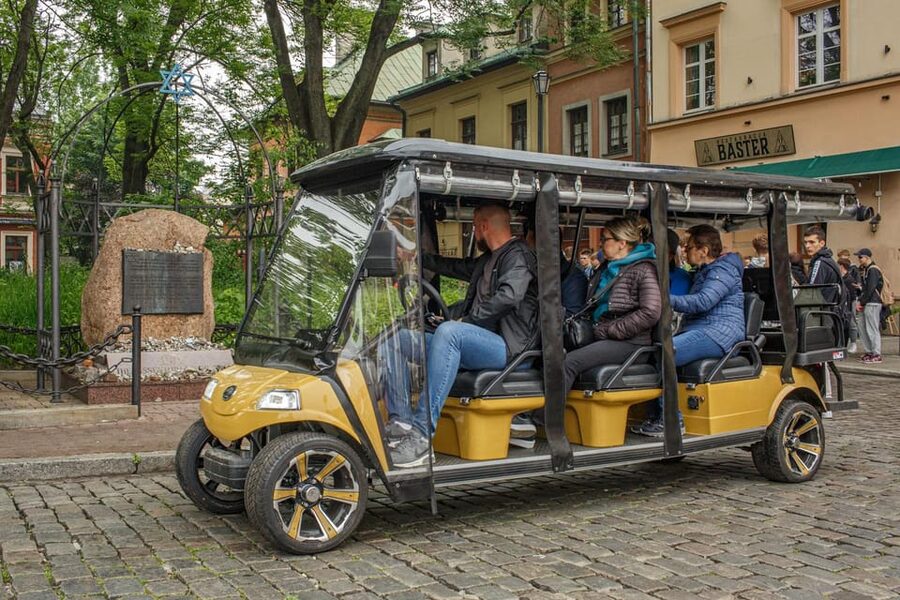
Krakow: Old Town – Kazimierz – Ghetto by Electric Golf Cart
Krakow can feel big on day one. This ride is interesting because it connects Old Town to Kazimierz and the former ghetto area in one smooth loop on an electric golf cart.
What I like most is that you get a live guide plus an audio guide system, so you are not stuck with only one way of learning. And because it is set up for language choice, it is easier to relax and actually follow what you are seeing.
One drawback to consider is that the tour is not for everyone, with strict age and height limits plus rules that keep the vehicle calm and uncluttered.
Key things to know before you go
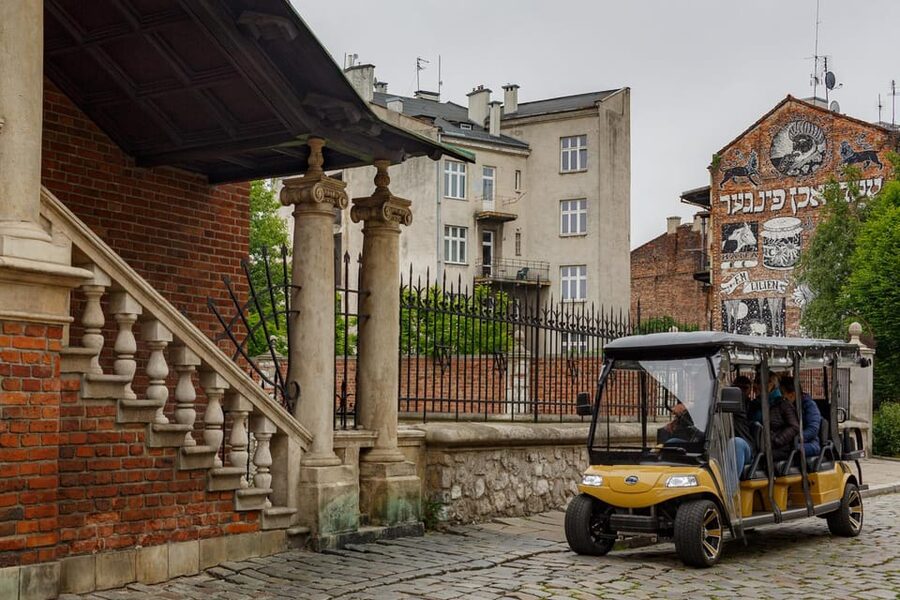
- Electric golf cart pace keeps you moving between districts without long gaps of walking
- Old Town, Kazimierz, and Podgorze together so the story of Krakow feels connected
- Live guide plus audio helps you understand what you are passing, at your preferred speed
- Stops built around named landmarks like St. Florian, Wawel Castle, multiple synagogues, and the ghetto wall
- Group trip with the chance to meet people while still having a structured route
Three Districts, One Route, 150 Minutes of Momentum
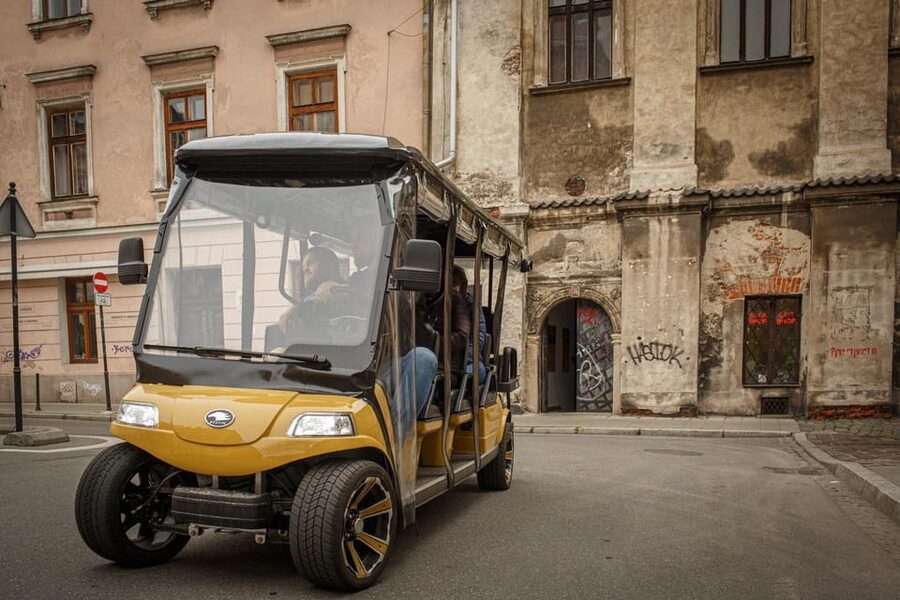
This is a 2-hour tour focused on the three areas that most shape Krakow’s modern identity: Old Town, Kazimierz (the Jewish district), and Podgorze (the former ghetto area). The value here is the way it puts these places in conversation, rather than treating them as three unrelated checkboxes.
The timing matters. With only 150 minutes, you do not have time to wander far off plan. But you do get enough time to get your bearings, learn what is where, and then decide what to return to later for longer stops.
You will also notice the tour’s structure is built around story points, not just photo stops. You hear history of Krakow, then you move into the Jewish Quarter’s named streets and synagogues, then you arrive at remembrance places connected to ghetto life and the ghetto wall.
More Jewish quarter and heritage tours to compare:
- Krakow: Schindler’s Factory & Ghetto Guided Tour
★ 4.7 · 1,694 reviews - Krakow: Jewish Quarter and Former Ghetto Tour
★ 4.9 · 1,441 reviews - Krakow: Bike Tour of Old Town, Jewish Quarter and the Ghetto
★ 4.9 · 1,155 reviews
Electric Golf Cart Pace, Quiet Streets, and Faster Sightlines
The main point of taking an electric golf cart is practical. You cover a lot of ground without the fatigue that can slow you down in a compact old city like Krakow. Instead of spending the whole day in transit or on uneven sidewalks, you sit, listen, and watch districts flow past.
It also gives you an in-between view. On foot, you can miss the overall layout. From a distance, you lose the human scale. This setup tends to land in the middle, where you can spot major landmarks like Main Square, Wawel Castle, and the barbacan area, while still understanding that you are moving through real neighborhoods.
Another practical win is the ride supports a multilingual approach. The driver is Polish and English, and the audio guide system is part of how the tour stays consistent in whichever language you choose. That is a big deal if you are traveling with someone who prefers a certain language, or if you want the narration to match how you think.
Old Town Stops, From Planty to Main Square
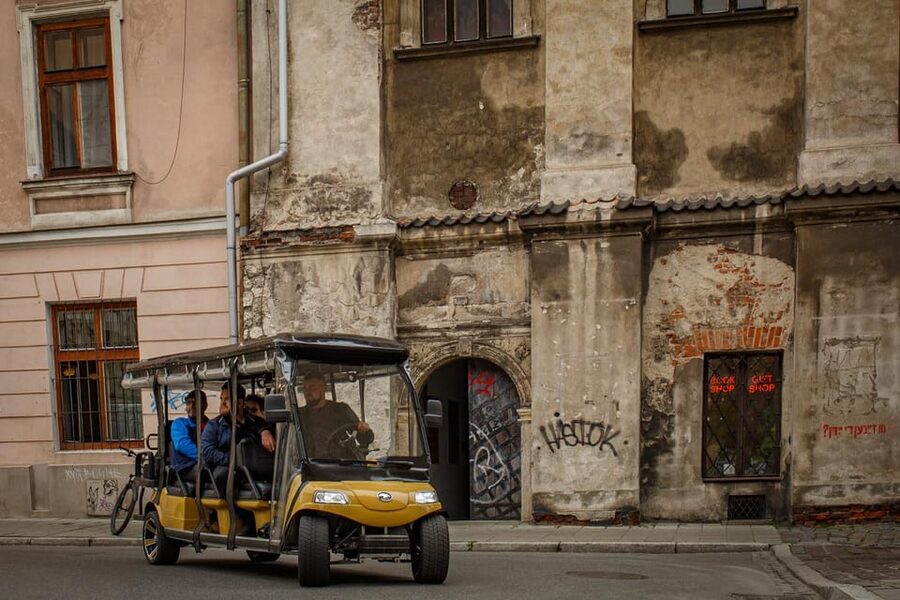
Old Town is where the tour helps you get oriented fast. Expect a route that builds from city foundations outward, using landmarks you can later point to when you are on your own.
You start with a general history of Krakow, then move toward Planty, which you can think of as a first anchor for the city center. From there, the tour shifts to a sequence of recognizable points: Church of St. Cross, Słowacki Theater, and the former city walls.
Those wall and defensive-history stops are a useful start, because they help you understand why the city’s core developed the way it did. Even if you do not spend time inside each site, you are learning the “why this area looks like this” foundation, and that makes later self-guided exploring easier.
Next comes the Barbican and Jan Matejko Square, then you head toward St. Florian and Sławkowska Street. The way these are paced feels like a guided map. You are not just seeing names, you are collecting a mental route you can follow later.
The tour also includes museums and church-heavy streets. You will pass Czartoryski Museum, then St. John’s Street and Church, before reaching Main Square. If Main Square is the first big “you are in Krakow” moment for you, this tour sets it up so you know what to look for beyond architecture and crowd photos.
After Main Square, you go through Plac Szczepański and the Palace of Art area, then St. Anne’s Church, Town Hall, and the Franciscan Church. These stops build a loop that feels like the old civic and cultural center of the city.
Finally, Old Town’s arc closes with Wawel Castle. Even without lingering for a deep visit here, it is a strong payoff point. You arrive with context already, rather than seeing it as a random big attraction at the end of your day.
Kazimierz Jewish Quarter, Synagogues and Streets With a Story
Kazimierz is where the tour becomes more specific and more emotional. You are not only passing landmarks, you are hearing a description of the Jewish Quarter. The audio and guide work together here, so you are not forced to guess what each street and building means in the larger narrative.
The route begins with places like Skałka Church and Church of St. Catherine, then moves toward Wolnica Square and the Jewish City Hall. From there, you step into a cluster of religious sites that the itinerary lists by name: Church of Corpus Christi, Tempel Synagogue, Kupa Synagogue, and Isaac Synagogue.
I like how this part of the tour is organized around named synagogues and distinct streets. It gives you handles, so later, if you want to do your own walking circuit, you can remember the order of what you saw and where. Ciemna Street shows up as well, followed by Old Synagogue.
The list continues with Popper Synagogue, then the Family House of Helena Rubinstein. That inclusion is helpful because it reminds you the Jewish community’s story is not only about places of worship. It is also about people and institutions in everyday life.
Remuh Synagogue and the old cemetery are also included, along with a memorial stone tied to the Nissembaum Family Foundation. Then you get Wolnica-style neighborhood flavor through stops like Old Jewish Shops.
Kazimierz is often one of the first places people want to return to after a first visit. This tour helps you make that decision. It is not a full-day walking immersion. It is a guided orientation with enough detail to point you toward the specific corners you will want to explore again.
More Old Town walking tours to compare:
- Old Town Krakow & Wawel Castle Walking Tour
★ 5.0 · 1,508 reviews - Krakow: Rynek Underground Museum Guided Tour
★ 4.6 · 1,122 reviews - Krakow: The Old Town Walking Tour
★ 4.8 · 794 reviews - Krakow: Old Town Guided Segway Tour
★ 4.7 · 756 reviews
Podgorze and the Former Ghetto, From Heroes Square to the Wall
Podgorze is the hardest and most important section of this route. The tour shifts from the Jewish Quarter’s everyday cultural map into the former ghetto area, with narration that describes the ghetto itself and life inside it.
You move to the former Ghetto area, then to Ghetto Heroes Square. After that, the route includes the Pharmacy under the Eagle, which is described as the residence of Tadeusz Pankiewicz. That stop matters because it connects a specific place name to a specific story tied to human help, not just general suffering.
The tour then brings in Oskar Schindler’s history. It also includes stops tied to “life in ghetto,” so you are hearing more than dates and locations. You are getting a framework for what it meant to live under those conditions, and the ghetto wall stop reinforces that physical reality.
You then finish with Church of St. Joseph. Even that closing stop feels intentional. It gives you a final reference point at the end of a difficult segment, before you shift back into normal travel mode.
For me, the value of this part is how it stays structured. In this theme, it is easy to leave with only fragments. A named stop list plus guided descriptions helps you keep the story organized in your head.
Meet a Guide You Can Follow, in the Language You Want
One of the smartest features here is the way learning is handled. You have a live guide, and you also have an audio guide system. That combination works well when you want both accuracy and flexibility.
If you prefer to listen while you sit and look, audio helps you keep moving without constantly asking questions. If you want a more human layer, the live guide brings context and can help you connect the dots as the route changes neighborhoods.
Language choice also matters. The driver works in Polish and English, and the experience is designed so you can explore the city in the language of your choice. That is the kind of detail that can turn a first-time city visit from stressful to straightforward.
In the small set of feedback tied to guides, names like Radar and Natalie showed up as people who were well received. The common thread was clear, competent guidance. You can treat that as a sign that this is not just a route read from a script.
Price, What You Get, and Why $41 Can Make Sense
The price is $41 per person for 150 minutes. On paper, that might look like “just a ride.” In practice, you are paying for three things at once: an electric vehicle, a live tour guide, and an audio guide system.
For first-time visitors, that combo can be good value because it compresses planning. You do not need to stitch together multiple tickets or worry about how to connect Old Town to Kazimierz to Podgorze. The itinerary is already grouped around those districts, with stops that act like markers for later exploration.
The other value point is group momentum. You meet new people on a group trip, and it keeps the day from feeling like a solo slog. If you are the type who likes to start with structure, this is exactly that kind of setup.
That said, you should weigh your own travel style. If you already know you want to spend most of your day walking into churches, museums, and synagogues on your own schedule, you might prefer longer, smaller-footprint experiences. This one is better for orientation, learning, and deciding what to do next.
Practical Fit, Rules, and What to Bring
This tour is built to stay orderly and comfortable on a vehicle. That means you should plan for a ride, not a walking marathon.
Bring water, since it is an outdoor city circuit and you will be out for about 150 minutes. Smoking is not allowed in the vehicle, and alcohol and drugs are also not allowed. Bags are also not allowed, along with electric wheelchairs and non-folding wheelchairs. Bikes are off the list too.
There are also strict limits around age and height, including children under 2 and many limits beyond that, plus restrictions for older ages. If you are traveling with kids, check carefully before you book. If you are on the taller or older end, same advice. This is not flexible in that way.
Because the tour is in an electric cart, it also tends to work best for adults and for people who are comfortable with a guided route format. If you love quiet listening and looking, you will likely enjoy it. If you want lots of free time for spontaneous detours, you may feel a little boxed in by the schedule.
Quick Stop-by-Stop Reality Check (So You Know What You Are Signing Up For)
You will see a long list of named places, from Church of St. Cross and Słowacki Theater to the Barbican and Town Hall. In the Kazimierz section, expect a string of synagogues and Jewish Quarter street names like Ciemna Street, plus sites like the Family House of Helena Rubinstein and Remuh Synagogue and the old cemetery.
Then the Podgorze section shifts into remembrance with stops tied to the former ghetto area, Ghetto Heroes Square, the Pharmacy under the Eagle connected to Tadeusz Pankiewicz, and Oskar Schindler’s history. The ghetto wall is a key visual marker at the end of that theme-heavy segment.
That is the best way to think about it: this is a guided tour that uses a lot of distinct named markers to build a mental map. It is not a single-site deep visit. If you treat it like a map with narration, it clicks. If you expect to spend long inside buildings, you might be disappointed.
Should You Book the Electric Golf Cart Tour of Krakow?
I think you should book this tour if you want fast orientation and a guided story that connects Old Town, Kazimierz, and the former ghetto area in one outing. The combination of live guide and audio guide is practical, and the cart pace helps you see more without burning out.
I would skip it if you need a highly flexible schedule, if you rely on carrying bags, or if age and mobility rules do not fit your group. Also, if your goal is deep museum time or long church visits, you will want a different plan after this, not instead of it.
If your top priorities are getting your bearings, learning the big context, and then choosing what to revisit, this $41, 150-minute loop is a smart first move in Krakow.
More Electric Buggy and Golf-cart Tours to Compare
- Krakow: City Sightseeing Tour by Electric Golf Cart
★ 4.5 · 3,264 reviews - Krakow: City Sightseeing Tour Eco Electric Buggy Golf Cart
★ 4.7 · 3,143 reviews - Krakow: Extended City Sightseeing Tour – Eco Buggy Golf Cart
★ 4.7 · 794 reviews - Krakow: Electric Car Sightseeing Tour
★ 4.4 · 450 reviews
Recently reviewed around Krakow
- Wawel Castle and Cathedral Guided Tour★ 4.6 · 44 reviews
- Walking Tour: Kazimierz, Jewish Quarter – 2-Hours of Magic!★ 4.7 · 35 reviews
- Wawel Castle and Cathedral Guided Tour★ 5.0 · 8 reviews
- Kraków Holocaust Tour★ 4.9 · 5 reviews
- Wadowice and Kalwaria: John Paul II Route★ 4.8 · 5 reviews
- VIP Club Entry and Booth Booking★ 5.0 · 4 reviews
- Walking Tour of Krakow: Old town – 2-Hours of Magic★ 4.7 · 5 reviews
- Krakow: Zakopane, Thermal Baths and Gorce Park Treetop Walk★ 5.0 · 3 reviews