
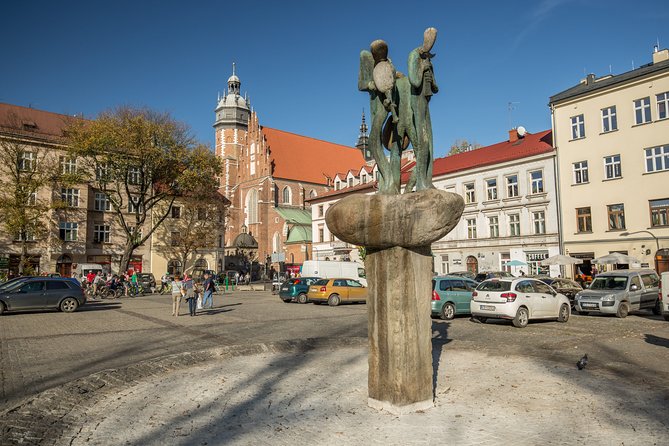
Reviewed · JEWISH QUARTER & HERITAGE TOURS
Krakow: Jewish Ghetto Guided Tour
A Podgórze Jewish Ghetto walking tour is interesting because it puts World War II history in the actual streets where it played out. You get a focused route through surviving landmarks and memorials, and you are not left guessing what you are looking at.
Two things I really like about this tour are the tight one-hour format and the fact that you have a guide handling the turns. That means you can spend your energy on meaning, not map work, which is exactly what you want in a place this heavy. A possible drawback: what you see today is not a full “time capsule,” so the sites can look smaller or more modern than you may expect.
Key things to know before you go
- One-hour walking route through Podgórze, designed to keep you oriented fast
- Free entry at the wall fragment and Ghetto Heroes Square stops
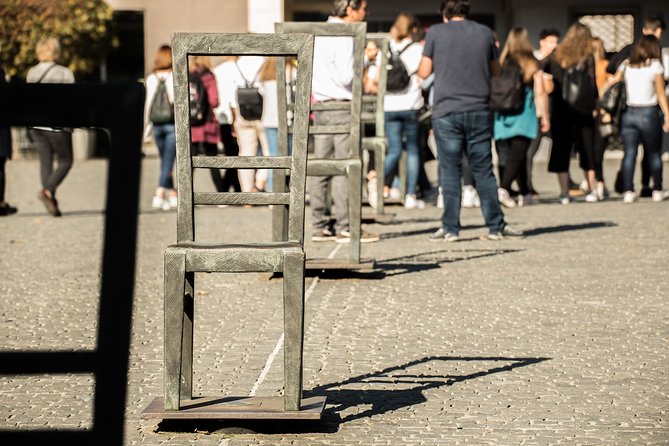
- Chair Memorial on Ghetto Heroes Square, tied to deportations
- Under the Eagle Pharmacy Museum (admission not included) and the story of medical help
- Small group size with a maximum of 20 people
- English-only guidance with mobile tickets for easy check-in
Why this Krakow Jewish Ghetto walk works so well in limited time
Krakow can be packed with big-ticket sights, so it is smart to pick experiences that are both concentrated and meaningful. This tour is built for that. In about an hour, you cover the key outdoor pieces in Podgórze, then optionally add time and context at the museum stop. It is the kind of format that fits well after Schindler’s Factory or before dinner, without swallowing your whole day.
The other reason it works is simple: you walk. A car tour can only give you broad strokes, but a walking route lets you experience confinement in a more personal way. You slow down, look at the edges of buildings and corners, and the history lands differently when you are at street level.
Finally, you should know the sites are what remains. The ghetto is not preserved in the way some people expect, so the power of the tour comes from interpretation, not from seeing walls and streets frozen in time.
More Jewish quarter and heritage tours to compare:
- Krakow: Schindler’s Factory & Ghetto Guided Tour
★ 4.7 · 1,694 reviews - Krakow: Jewish Quarter and Former Ghetto Tour
★ 4.9 · 1,441 reviews - Krakow: Bike Tour of Old Town, Jewish Quarter and the Ghetto
★ 4.9 · 1,155 reviews
Meeting point, timing, and what to expect on the ground
The tour starts at Lipowa 4, 32-051 Kraków, and finishes at Apteka pod Orłem, Plac Bohaterów Getta 18, 33-332 Kraków. The operator notes it is near public transportation, which is handy if you are bouncing between districts.
Plan on about 1 hour total. Groups are capped at 20 people, which helps the guide keep the pace clear and understandable. It is English-only, and you receive a mobile ticket.
One practical tip that matters here: arrive about 10 minutes early. Once the group departs, latecomers cannot join, and tickets are not refunded. If you are combining this with other Krakow stops, give yourself time to move across town. If you have been somewhere like Schindler’s Factory first, don’t plan to rush. The start time is real.
Stop 1: The Ghetto Wall Fragment and the reality check of what survives
Your first stop is the remains of the ghetto wall. This is the kind of place that hits fast, because a fragment is enough. You do not need a perfect reenactment to understand the idea of separation. The stone and the boundaries are stark reminders that this city once had lines drawn through people’s lives.
At this stop, admission is free, so you are not paying extra just to get in. What you are paying for is what the guide brings to the scene. The tour is paced so you can focus on what this wall fragment represents and how the “shape” of the ghetto connected to daily life.
A consideration: since you are seeing what is left, it may look smaller than you imagined. That is normal. The guide’s job is to help you connect the fragment to the bigger picture so your visit does not feel disconnected.
Stop 2: Ghetto Heroes Square and the Chair Memorial
From there you walk into Ghetto Heroes Square, described as the heart of the ghetto. This is where the tour’s emotional weight increases, because this square connects to deportations to extermination camps. It can feel heavy on the body, not just the mind.
The key feature here is the Chair Memorial. Each chair represents lives lost, and the placement makes you pause in a way a plaque alone rarely does. This is one of those outdoor memorials where a short stop becomes a moment you will remember later.
Admission at this square is free, so again the cost is in the guided explanation and the route planning that gets you here without detours. The square is also a good checkpoint for your attention. If you have a tendency to glaze over at monuments, you will probably find the chair memorial works better when a guide gives you the story behind it.
A few more Krakow tours worth comparing
- From Krakow: Auschwitz-Birkenau Guided Tour & Hotel Pickup
★ 4.5 · 33,358 reviews - From Krakow: Auschwitz-Birkenau Guided Tour & Hotel Pickup
★ 4.5 · 29,340 reviews - Krakow: Auschwitz Guided Tour with Optional Hotel Pickup
★ 4.5 · 15,280 reviews - Krakow: Auschwitz-Birkenau Guided Tour with Pickup & Lunch
★ 4.5 · 9,800 reviews
Stop 3: Under the Eagle Pharmacy and Tadeusz Pankiewicz’s work
Across the square stands the Under the Eagle Pharmacy area, tied to the Eagle Pharmacy museum. Here the tone shifts from confinement to courage and human effort. The tour highlights Tadeusz Pankiewicz and his staff, who aided ghetto residents and helped preserve medicine and hope.
This is where the tour becomes more than a bleak walk. The pharmacy focus gives you something concrete to grasp, because medicine is not abstract. It is about daily survival, about keeping bodies alive long enough to endure.
Important detail: admission for this museum is not included. That means your total time may depend on how long you want to spend inside and whether you are able to get through with your group schedule. If you want the deepest context here, you may enjoy adding a bit of extra time, but the tour itself keeps moving.
If you are sensitive to heavy topics, this stop can still be a good choice. It does not soften what happened, but it reminds you that resistance and care existed even in the worst conditions.
Why the guides make a big difference on a 1-hour route
The tour lives or dies by clarity, and guides are a major part of the experience. In this case, you can expect a guide who explains in a calm tone and keeps the pace readable for a walking group. People have praised guides like Olga, Anna, and Phil(illip) for answering questions and giving context in an easy way.
You also get help with navigation. One highlight is that you will reach places car tours cannot reach, and the route makes sense as you walk. Without that, you might stand at a memorial and feel like you missed something. With a guide, you get the “why here” and “what this means” right away.
Some guides also use visual support, including printed materials, which helps a lot in a historical walk where the setting may not match your mental image. And because the group is small, you can usually hear the explanations without straining.
The reality of walking through modern Krakow on old history
A practical expectation shift helps: today’s ghetto locations look different from how people imagine them in wartime. You will not be walking through intact walls and crowded scenes. You are moving through a modern city, and that can be emotionally disorienting at first.
That is exactly why guided framing matters. When a guide links the current view to what the area meant then, your brain builds the missing pieces. You might still feel a little detached at first, especially if you came in with a strong visual expectation. Give it a minute and let the tour build the connections step by step.
Also remember: rain and shine. The tour goes ahead in all weather. Bring clothing that works if the streets get slick. Even in good weather, expect uneven sidewalks and real walking time, so plan for it.
Getting the most from this tour: shoes, questions, and pacing
This is a short tour, so you want to be ready. Wear comfortable shoes, and treat the walk like part museum, part street-level lesson. If you show up in dress shoes or thin soles, your feet will start complaining before your mind catches up.
If you want better results, do two simple things:
- Come with one or two questions about what you have seen already in Krakow, so the guide can connect dots.
- Stay mentally in the stops, not on your next schedule. The whole point of a one-hour focus is staying present.
If you are combining sites on the same day, build in time gaps. Starting on time is required, and the operator asks you to arrive early. I find that historic tours go better when you are not sprinting between locations.
Price and value: what $15.60 buys you in Krakow
At $15.60 per person for about one hour, this is positioned as a budget-friendly option. The value angle is not only the price. Two of the three main stops have free admission, so a big part of what you are paying for is the guide and the route logic that gets you to the right places in the right order.
You are also paying for reduced friction. You are not spending your time researching or building a perfect walking plan through a tough subject area. That matters because you can easily waste half a day doing “history homework” instead of actually seeing the sites and learning what connects them.
One extra cost consideration: the Eagle Pharmacy museum has admission not included. If you plan to go inside, check your expectations. Budget a little extra time and money for that final stop if the museum experience is important to you.
Overall, for a focused WWII-era walking route with memorial stops and interpretation, this is strong value for the time you spend.
Who should book this Krakow Jewish Ghetto Guided Tour
This tour is a good fit if you:
- Want a short, guided walk focused on Podgórze without overcommitting time.
- Prefer having someone handle navigation, instead of trying to piece together meaning on your own.
- Like learning from locals who can explain context clearly, and keep the pace manageable.
- Are pairing it with other nearby Krakow experiences and want a coherent story arc.
It is also smart for first-time visitors who feel overwhelmed by too many choices. The stops are straightforward, and the route avoids “guessing” moments.
If you are someone who expects to see a fully preserved ghetto environment, you should adjust your mindset. You are seeing what survives and learning the story around it, and that is a very different experience than seeing an intact historical set.
Should you book? My take on whether it is worth it
If you want an efficient way to understand the Jewish Ghetto sites in Podgórze, this is a solid booking. The strongest reasons are the tight one-hour format, the small group size, and the combination of memorial stops and a meaningful museum connection at Under the Eagle Pharmacy.
I would especially recommend it if you care about getting the story right. This is not a walk where you can just wing it and “figure it out later.” The places are real, but the significance needs explanation, and the guide experience is the whole point.
Book it if you can arrive a little early, wear good walking shoes, and keep your focus on the route. If your schedule is too tight to show up on time, consider adjusting. Otherwise, you’ll miss the start and the tour does not wait around.
FAQ
How long is the Krakow Jewish Ghetto guided tour?
The tour lasts about 1 hour.
What is the price per person?
The price is listed as $15.60 per person.
What language is the tour offered in?
The tour is offered in English only, as only one language is used per group.
Where does the tour start and end?
It starts at Lipowa 4, 32-051 Kraków, Poland and ends at Apteka pod Orłem, Plac Bohaterów Getta 18, 33-332 Kraków, Poland.
How big are the groups?
The group has a maximum of 20 travelers.
Is the ticket mobile?
Yes, the tour uses a mobile ticket.
Is admission included for all stops?
Admission is free at the Ghetto Wall Fragment and Ghetto Heroes Square stops. Admission for the Under the Eagle Pharmacy Museum is not included.
What should I wear or bring for the tour?
Wear suitable clothing and footwear for walking. The tour goes ahead in all weather, rain or shine.
When should I arrive before the tour starts?
Please arrive 10 minutes before the tour begins. Latecomers cannot join once the group has departed, and tickets cannot be refunded.
What is the cancellation policy?
You can cancel for free up to 24 hours in advance for a full refund. Changes made less than 24 hours before the start time are not accepted.
Recently reviewed around Krakow
- Wawel Castle and Cathedral Guided Tour★ 4.6 · 44 reviews
- Walking Tour: Kazimierz, Jewish Quarter – 2-Hours of Magic!★ 4.7 · 35 reviews
- Wawel Castle and Cathedral Guided Tour★ 5.0 · 8 reviews
- Kraków Holocaust Tour★ 4.9 · 5 reviews
- Wadowice and Kalwaria: John Paul II Route★ 4.8 · 5 reviews
- VIP Club Entry and Booth Booking★ 5.0 · 4 reviews
- Walking Tour of Krakow: Old town – 2-Hours of Magic★ 4.7 · 5 reviews
- Krakow: Zakopane, Thermal Baths and Gorce Park Treetop Walk★ 5.0 · 3 reviews